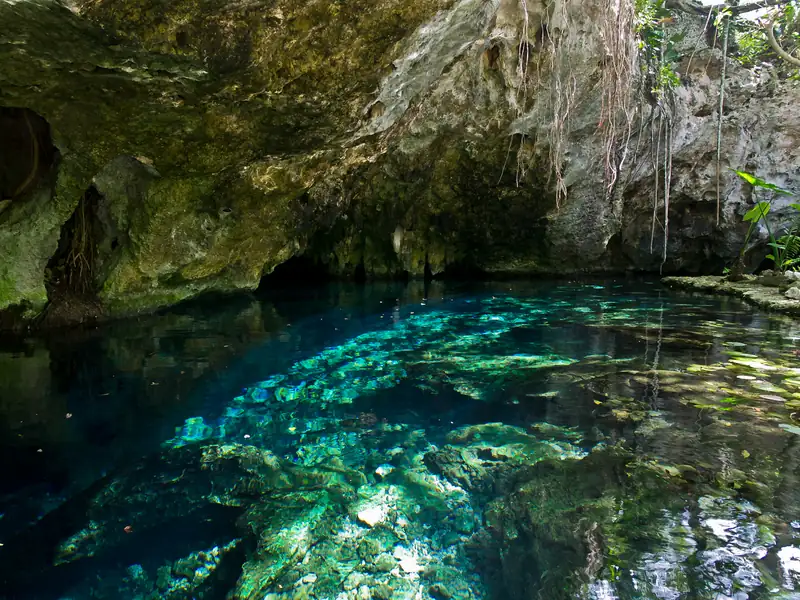
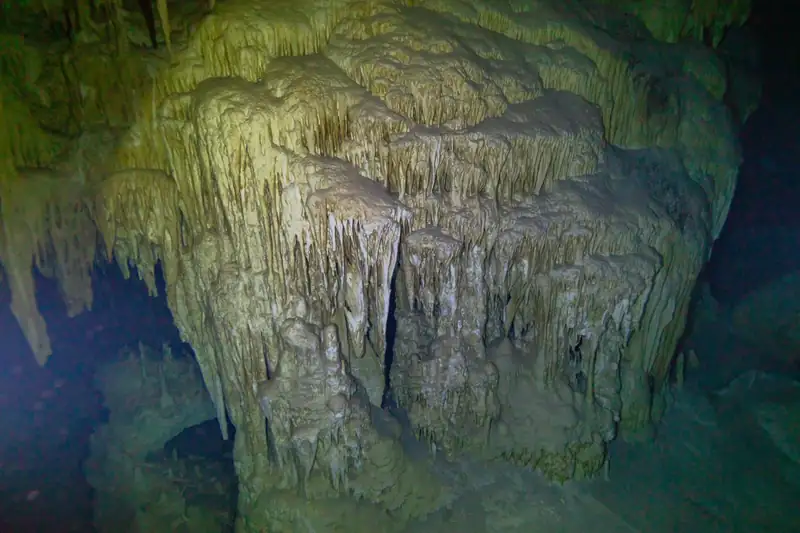
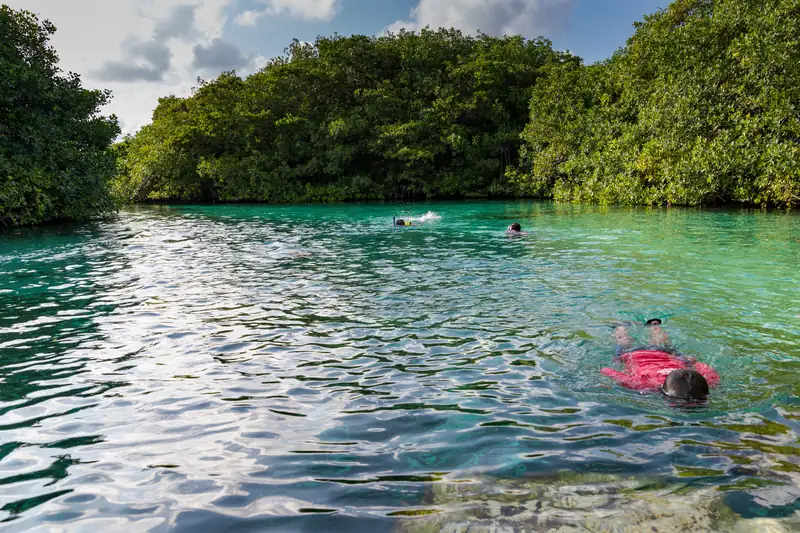
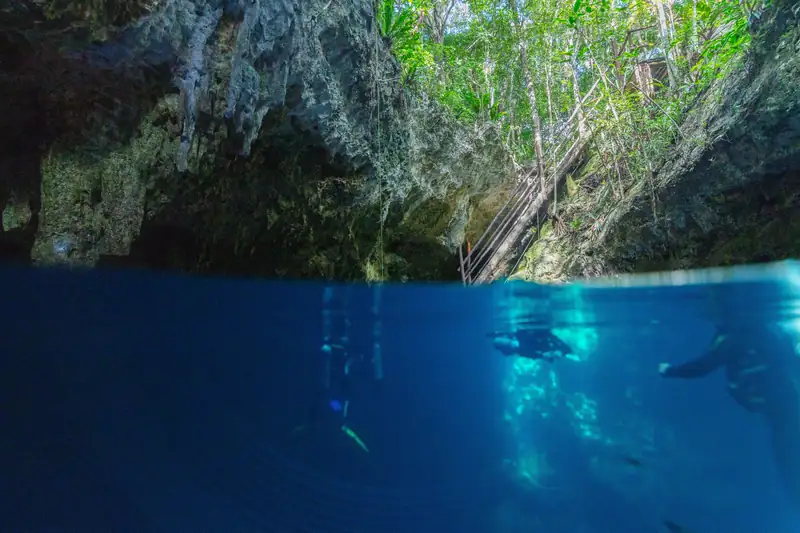
A cenote is a natural pit where the limestone roof has collapsed and exposed the groundwater below. The word comes from the Yucatec Maya tsʼonoʼot, a place with reachable water. The Yucatán Peninsula has an estimated 10,000 of them. Around Tulum they come in four rough types: open, semi-open, cavern and cave.
A cenote is a natural pit where the limestone ground has caved in and exposed the groundwater underneath. You get a hole in the jungle floor filled with clear fresh water, sometimes open to the sky and sometimes hidden under a rock roof. The word is Maya: Spanish speakers borrowed it from the Yucatec tsʼonoʼot. The Yucatán Peninsula has an estimated 10,000 of them, and the stretch around Tulum has some of the best known, including Gran Cenote and Dos Ojos.
Cenote meaning: a Maya word for water
Tsʼonoʼot, also written dzonot or tz’onot, meant any place with accessible groundwater. It did not need to be pretty, or even open to the sky. What mattered was that you could get water out of it.
That mattered here. The Yucatán has almost no rivers on the surface, so for the Maya, cenotes were the main year-round source of drinking water. They were also places for offerings and burials, which the Maya cenotes guide covers in detail.
It starts with rain. Rainwater is slightly acidic, enough to dissolve limestone very slowly. Over a long time it eats out voids and passages under the surface.
Then the roof gives way. Where a void sits close to the surface, the rock above thins until it falls in and leaves an opening onto the water. The fallen blocks keep dissolving at the bottom, which makes room for more of the roof to drop. A cenote is a collapse still in progress, on a geological clock.
The water itself is layered. Near the coast, fresh rainwater floats on top of heavier salt water that seeps in from the sea, and the two meet at a boundary called the halocline. Swimmers and divers see it as a blurry, shimmering layer, like heat haze underwater. At the coast the halocline lies 10 to 20 m below the water table; inland it is 50 to 100 m down. In some cave-connected cenotes the water moves up to 10 km a day.
Tulum’s cenotes are doors into flooded caves
Around Tulum, most cenotes are not isolated pits. They are openings into enormous flooded cave systems. In January 2018 divers connected the Sac Actun system to Dos Ojos, making a single system of 347 km, which at the time made it the longest underwater cave known. It no longer holds that title: Ox Bel Ha, also near Tulum, is longer, at 541.7 km surveyed as of February 2026 according to the cave survey group CINDAQ. The Sac Actun guide has the full story.
What about the asteroid?
You will read that the cenotes were made by the Chicxulub impact that ended the age of the dinosaurs 66 million years ago. That is true for one group of them, and not for Tulum. A ring of cenotes traces the buried rim of the Chicxulub crater, but that ring is in Yucatán state, centred near Progreso on the north coast, about 300 km from Tulum. Tulum’s cenotes belong to a different, coastal cave network.
Cenote vs sinkhole
“Sinkhole” is the general word for a hole that opens where soluble rock such as limestone collapses or dissolves. A cenote is a sinkhole that reaches the water table, so it holds groundwater. Every cenote is a sinkhole, but a dry sinkhole is not a cenote.
Types of cenote: open, semi-open, cavern and cave
Guides and tour operators sort cenotes into four types. This split is plain-language usage rather than a scientific standard, but it tells you what to expect when you arrive. (The academic scheme, from Frank Hall in 1936, uses different categories: jug-shaped, vertical-walled, shallow basin and cave-like.)
| Type |
What it looks like |
Example near Tulum |
Good for |
| Open |
Fully open to the sky, like a pond or pool |
Cenote Zacil-Ha, Cristal and Escondido, Car Wash |
Families, easy swimming |
| Semi-open |
Partly under a rock overhang |
Gran Cenote, Cenote Calavera |
Snorkeling, jumping (Calavera) |
| Cavern |
Inside a cave but within sight of daylight |
Dos Ojos |
Snorkeling, guided cavern dives |
| Cave |
Beyond the reach of daylight |
Taak Bi Ha (guided sections), the Cobá cenotes |
Guided visits; cave diving for certified cave divers only |
The line between them blurs. Gran Cenote is two open pools joined by a cavern section, so guides call it semi-open, cavern, or both. Casa Cenote is something else again: an open, brackish channel in the mangroves with a halocline only about 3 m down. A resident crocodile bit a visitor there on 12 May 2026, and whether swimming is now limited is not confirmed, so check before you go.
For divers the cavern and cave distinction matters most. A cavern dive stays where daylight is visible and needs only Open Water certification plus good buoyancy. A cave dive goes past the light and needs cave training. The cenote diving guide explains both.
If you want to see the contrast in one morning, the private Sac Actun tour in our top pick visits two cenotes, one a cave and one open to the sky, with a meal before the drive back.
Are cenotes full of human remains?
Some hold human bones. Most of the ones you swim in do not, as far as any source shows.
The famous case is the Sacred Cenote at Chichén Itzá, in Yucatán state. Edward H. Thompson began dredging it in 1904 and pulled up skeletons and offerings, and later work counted at least 120 individuals. A Spanish bishop, Diego de Landa, wrote around 1566 that people were thrown into it alive in times of drought. But even that is not the whole picture. At Punta Laguna, none of the roughly 120 individuals studied showed signs of sacrifice.
Then there are much older remains. Divers found the skeleton of a teenage girl, now called Naia, in a flooded pit called Hoyo Negro in the cave networks north of Tulum in 2007. She lived 12,000 to 13,000 years ago, thousands of years before the Maya. Hoyo Negro is not open to visitors.
No source we found ties sacrifice or human remains to any swimming cenote around Tulum. The Maya cenotes guide and the Chichén Itzá day trip guide go further into the history.
Seeing one for yourself
The closest cenotes to Tulum town are on the road to Cobá. Calavera is about 3.3 km out and Gran Cenote about 5 km, both easy by bike or taxi; the getting around guide has the options and the cenote map shows where each one sits.
Gates take cash in pesos. No cenote publishes its prices officially, and the boards at the gate change without notice. For Gran Cenote, several 2026 guides report about 500 MXN for an adult; the cenote entrance fees guide has the reported ranges for the rest.
Before you get in, shower, skip the sunscreen and leave the formations alone. The cenote swimming guide covers the rules and what to bring, and the tours page lists guided trips if you would rather not drive.