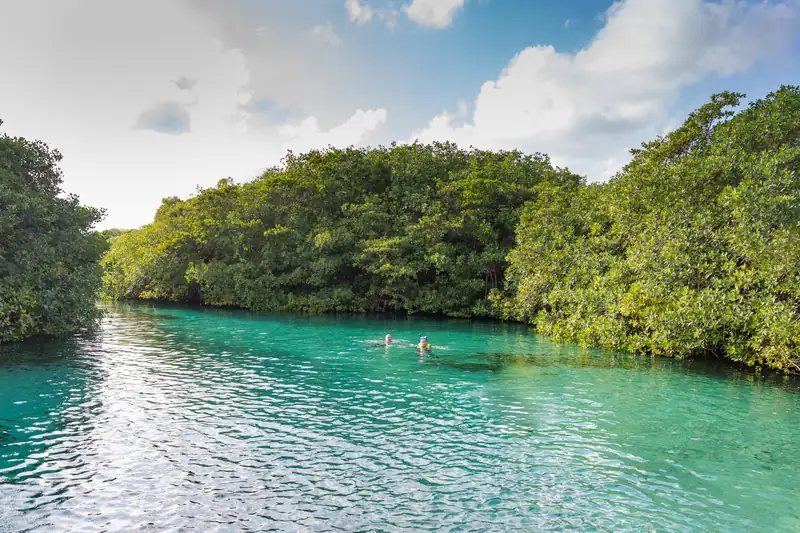
Cenote Dos Ojos, the two eyes cenote, is a pair of cenotes joined by a large cavern in Parque Dos Ojos, about 22 km north of Tulum off Highway 307. 2026 guides report a swim fee of 350 to 500 MXN. It suits snorkelers who want a real cavern and divers on a first guided cavern dive.
Cenote Dos Ojos (“two eyes”) is two cenotes joined by one large cavern, in Parque Dos Ojos off Highway 307 about 22 km north of Tulum. You can swim and snorkel in both eyes, take a guided snorkel into the darker Bat Cave, or cavern dive on guided lines that stay within sight of daylight. 2026 guides report a swim fee of 350 to 500 MXN, the higher figures in October. Come here if you want more cavern than Gran Cenote gives you and you have a car or a tour.
The same park holds three more names that searchers look for: The Pit, Nicte-Ha and Taak Bi Ha. They are covered below.
Dos Ojos at a glance
Checked October 2026:
|
|
| Where |
Hwy 307 km 124, north of Tulum; a dirt road of a few km runs from the highway gate to the cenote |
| Drive |
21.9 km, about 28 min to the water (free-flow estimate) |
| Swim and snorkel |
450 to 500 MXN in October 2026 guides; about 350 in earlier 2026 guides; 650 in an outlier |
| Guided Bat Cave snorkel |
About 600 to 800 MXN |
| Guided cavern dive |
About 1,600 MXN |
| Hours |
8:00 to 17:00 |
| Facilities |
Restaurant and coconut stands at the entrance, picnic areas, showers, toilets |
| Water |
About 24°C all year (dive-blog figure) |
These are reported prices. The ejido sets them and posts them at the gate; the cenote entrance fees guide compares every cenote.
Who runs Dos Ojos
The park sits on land of Ejido Jacinto Pat, a communal landholding group. According to a report in El Universal, the ejido has 172 members, holds more than 8,000 hectares along the Playa del Carmen to Tulum highway and began cenote and cave tourism in 1995. The same report says the ejido’s opposition moved the Tren Maya route inland, away from the park. That comes from one press source.
parquedosojos.com is not the park’s official site. We found no official website for Dos Ojos.
How to get to Dos Ojos from Tulum
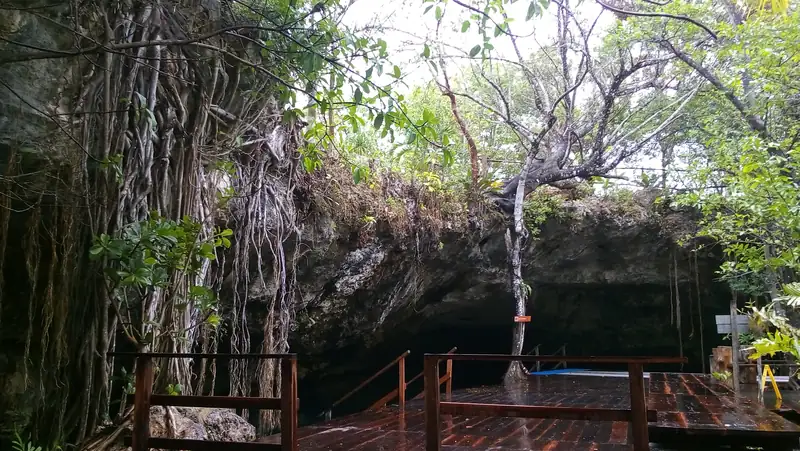
Drive north on Highway 307 to the park entrance at km 124. After the ticket gate a dirt road of a few kilometres leads to the cenote.
Colectivos (shared vans) on 307 will drop you at the highway entrance. From there a 2023 dive blog puts the walk to the water at about 30 minutes. A tour or taxi is easier; the getting around Tulum guide covers both. The Tulum cenote map shows Dos Ojos with The Pit, Nicte-Ha and Taak Bi Ha.
What to expect
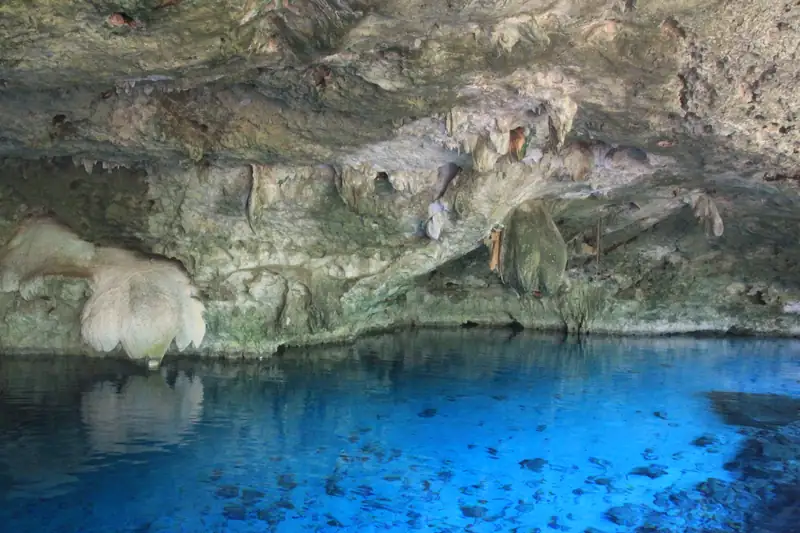
The two eyes are neighbouring cenotes, and a large shared cavern links them under the rock. Swimmers wear life jackets and stay in the open, daylit areas of both eyes.
The Bat Cave. Snorkelers can go into the Bat Cave only with a local guide, who carries the light. Bats live in the cave; a dive blog advises rinsing your ears afterwards.
Cavern diving. Divers follow two guided lines, the Barbie line (about 6 m deep) and the Bat Cave line, about 500 m together. Cavern dives stay where daylight is visible, so Open Water certification plus good buoyancy is enough, with a guide who is a full cave diver. Going beyond the daylight is cave diving and needs cave training. The cenote diving guide explains the difference.
Rules
- Life jackets are compulsory for swimmers.
- No sunscreen or insect repellent. Cenotes ask visitors to shower and skip sunscreen; rules on “natural” products vary, so wear a rash guard instead.
- Cavern divers need Open Water certification and a qualified guide.
- Bring cash. A 2023 blog said cash only; 2026 guides say not every gate has a card reader.
The Pit
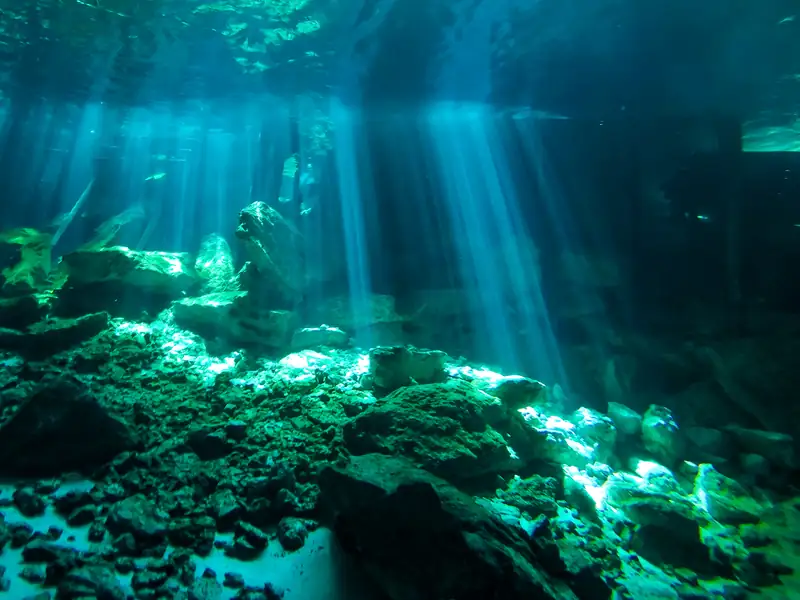
The Pit is a separate cenote in the same park, about 2 km west of Dos Ojos. It holds the deepest known passage in Quintana Roo, at 119.1 m, found in 1996. Recreational dives go to about 30 m, passing through a cloud of hydrogen sulfide, with sunbeams visible down to about that depth. It is for advanced divers with a guide; freedivers also use it. One dive operator raised its combined Pit and Dos Ojos site fee from 600 to 900 MXN in January 2025.
Cenote Nicte-Ha
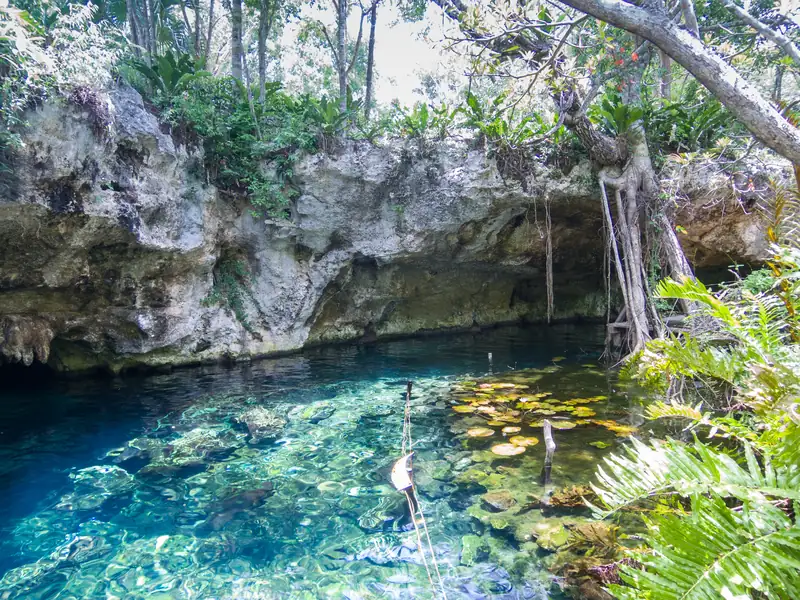
Nicte-Ha is about 350 m past Dos Ojos on the same ejido property. It is an open cenote with water lilies, about 10 m deep, and popular with cavern divers. Fins are banned for surface swimmers. Its fee is reported as 350 MXN or as part of a combined Dos Ojos ticket; which applies in 2026 is not confirmed, so ask at the main gate.
Cenote Taak Bi Ha
Taak Bi Ha is a cave cenote about 3 km past the Dos Ojos ticket gate along the dirt road, signposted on the left. Stairs lead down to clear water under stalactites, and a river-like section can only be visited with a local guide carrying a lamp. A July 2026 guide reports 350 MXN to swim and 400 MXN with a guide. It is run by the local community that owns it. Do not hang on the formations or roots.
Dos Ojos and Sac Actun
Sistema Dos Ojos had 82.5 km of surveyed passages and 28 cenote entrances before 2018, and its caves were filmed for the IMAX film Journey into Amazing Caves (2002) and BBC Planet Earth (2006). In January 2018 the Gran Acuífero Maya project connected it to Sistema Sac Actun. By caving convention the longer system keeps its name, so Dos Ojos is now part of Sac Actun. The Sac Actun guide has the numbers and the guided tour north of the park.
Gran Cenote vs Dos Ojos
Gran Cenote is 5 km from town on the Cobá road, has turtles and is reported at about 500 MXN. Dos Ojos is 22 km away on Highway 307, has the larger cavern and the Bat Cave, and is reported at 350 to 500 MXN. Without a car, Gran Cenote is the easy choice. With one, Dos Ojos plus Taak Bi Ha or Nicte-Ha makes a fuller day.
Tips
- Arrive at the 8:00 opening to get ahead of the tours.
- Bring cash pesos in small notes for the gate, guides and food.
- Bring water shoes and a towel; towels are rarely rented at cenotes.
- Allow time for the dirt road from the gate in both directions, and leave before the 17:00 close.
Cenotes near Dos Ojos
Cenotes Casa Tortuga gives its address as Ejido Jacinto Pat too, about 5 km away by straight line. The Sac Actun tour site is close to the park. Back toward Tulum, Casa Cenote sits on the coast at Tankah Tres. If you want to stay closer than town, the where to stay in Tulum guide lists hotels on Highway 307. Every cenote is listed on the Tulum cenote guide homepage, and tours are on the tours page.