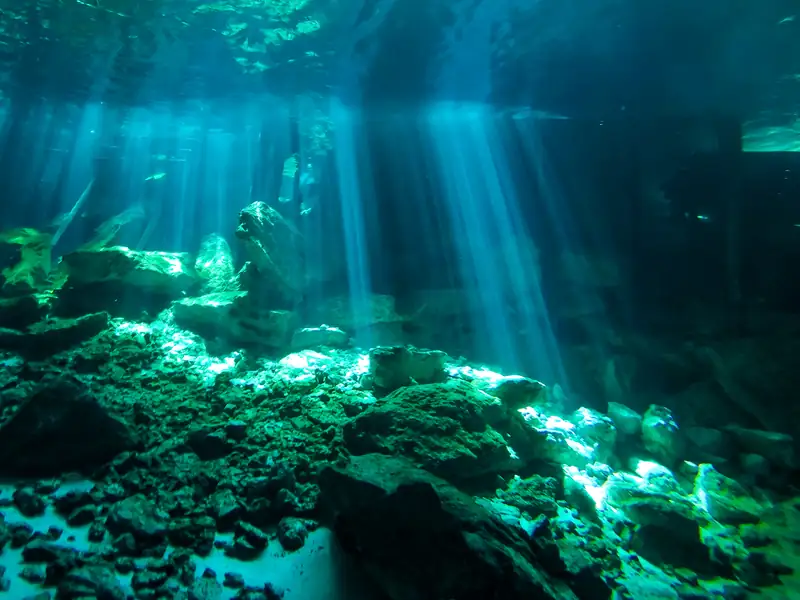
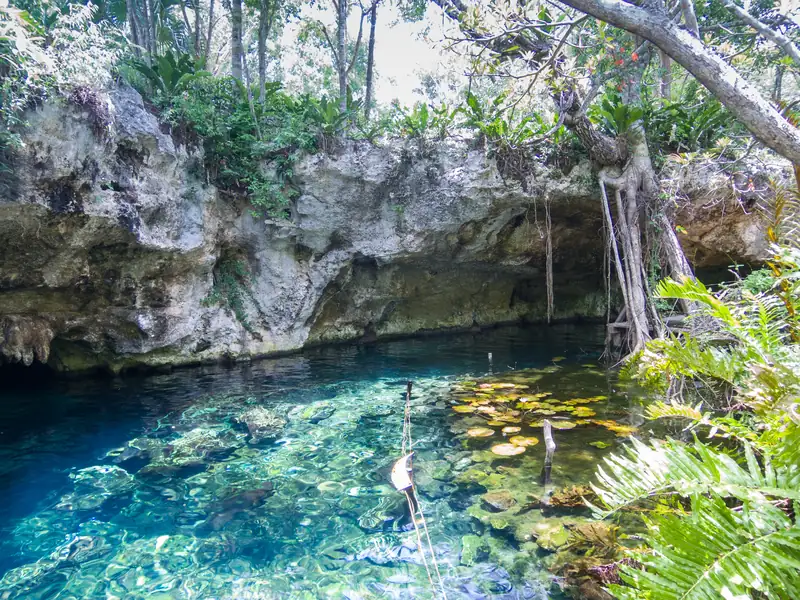
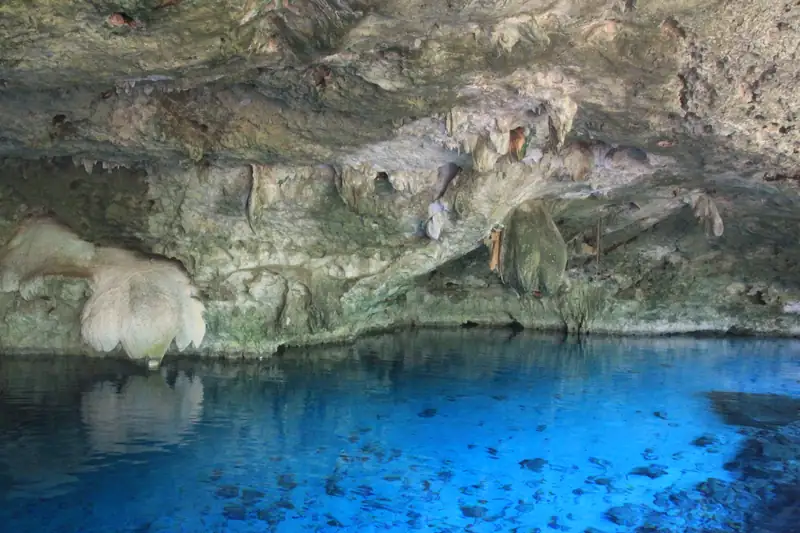
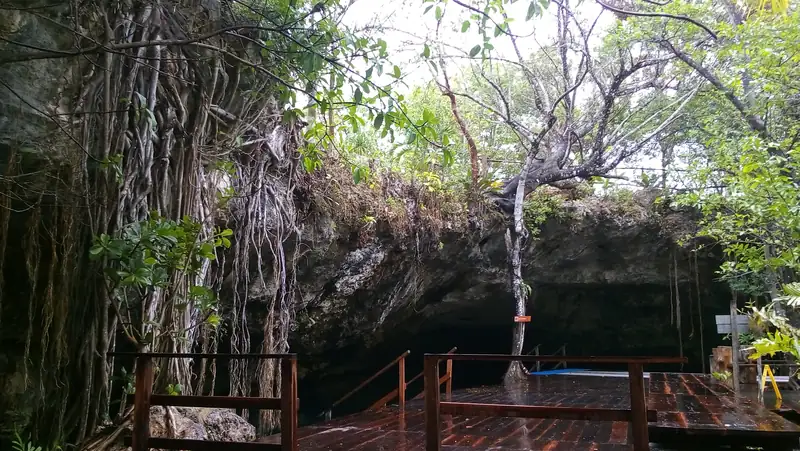
Sac Actun is a flooded cave system under the jungle north and west of Tulum, with about 378 km of surveyed underwater passages. Gran Cenote is its best-known entrance, and Dos Ojos joined it in 2018. Visitors see it on a guided snorkel tour at the Sac Actun cenote site near Dos Ojos, or by swimming at Gran Cenote.
Sac Actun (“white cave”) is a flooded cave system under the jungle north and west of Tulum. Divers have surveyed about 378.6 km of underwater passages, 386.1 km counting the dry caves, with a deepest point of 119.2 m (January 2023 survey). You can see it two ways without cave training: swim at Gran Cenote, the entrance where exploration began, or take the guided snorkel tour at the Sac Actun cenote site near Dos Ojos, about 25 km north of town.
Sac Actun in numbers
Checked October 2026:
|
|
| Underwater length |
378.56 km (Quintana Roo Speleological Survey list, 10 January 2023) |
| Including dry caves |
386.12 km |
| Deepest point |
119.2 m |
| Where exploration began |
Gran Cenote, 5 km west of Tulum |
| 2018 connection |
Sac Actun (263 km) + Dos Ojos (84 km) = 347 km |
| Longer system nearby |
Ox Bel Ha, 541.7 km (CINDAQ, February 2026) |
The 2018 connection, and why it is no longer the longest
In January 2018 divers with the Gran Acuífero Maya (Great Maya Aquifer) project, led by Robert Schmittner, found the link between Sistema Sac Actun, then 263 km, and Sistema Dos Ojos, then 84 km. The joined system measured 347 km and was reported worldwide as the longest underwater cave known. By caving convention the longer system keeps its name, so Dos Ojos became part of Sac Actun.
That record did not last. Sistema Ox Bel Ha, south-west of Tulum, has since been surveyed further: 541.7 km by February 2026, according to the annual report of CINDAQ, a cave research group. So Sac Actun is now one of the two longest underwater cave systems known, and both are near Tulum. Many travel sites, and the title of the tour on this page, still use the 2018 superlative. Mammoth Cave in Kentucky remains the longest cave of any kind.
The Sac Actun cenote tour
The site sold as “Sac Actun” is not Gran Cenote. It is a separate cenote north of Tulum near the Dos Ojos park, run by an operator called Cenotes Sac Actun, whose area also includes the Pet Cemetery cenote.
- Where: off Highway 307, 24.9 km from Tulum town, about 39 minutes by car.
- What happens: a guided group snorkel in the cave. A visitor review describes a one-hour tour with wetsuit, mask and life jacket provided.
- Price: the operator’s website lists USD 40 per person, but the site looks old and the price is undated. A review reports 650 MXN, paid by cash or card. Another 2026 guide gives about 290 MXN, converted from dollars. Treat all three as unconfirmed.
Pet Cemetery is named, according to guides, for animal skeletons in the cave; we found no primary source for that. A dive operator’s fee list said it was closed to divers, with snorkelling still possible. That list is no longer online, so the status is not confirmed for 2026.
The GetYourGuide pick on this page is a private tour that visits Cenotes Sac Actun and Cenote Xunaan Ha, with pickup from Tulum, Playa del Carmen, Puerto Morelos or Puerto Aventuras.
Gran Cenote: the easy way into the system
Gran Cenote is 5 km from town on the Cobá road and is where exploration of Sac Actun began. You can swim and snorkel the cavern section that links its two pools on a normal ticket, reported at about 500 MXN in 2026 guides. It is the simplest way to swim in Sac Actun water.
Dos Ojos, now part of the same system, has a larger cavern and guided dives.
Naia and Hoyo Negro
In 2007 cave divers Alejandro Álvarez, Alberto Nava and Franco Attolini found the way into Hoyo Negro (“black hole”), a bell-shaped flooded pit. At the bottom lay the skeleton of a teenage girl, about 15 or 16 years old, alongside the bones of Ice Age animals. She lived 12,000 to 13,000 years ago and is known as Naia. The project was directed by Pilar Luna Erreguerena of INAH, and the results were published in Science in 2014. Her mitochondrial DNA links her to modern Native Americans. The researchers describe her as the oldest, most complete and genetically intact human skeleton in the New World.
Sources disagree on which system Hoyo Negro belongs to: one places it in Sac Actun, another in a neighbouring system called Aktun Hu. Either way it lies in the flooded cave networks north of Tulum, and only technical cave divers can reach it. It is not open to visitors. The Maya cenotes guide has more on what has been found in the caves.
Threats to the system
In June 2026 the newspaper Por Esto reported that a Tulum ring road was being built through jungle near Sac Actun and Hoyo Negro. An activist quoted in the article said Profepa, the federal environmental agency, had halted the works the year before for illegal clearing and that they had restarted. The article gave no documents, so treat these as claims.
Diving Sac Actun
Cavern dives at Gran Cenote and Dos Ojos need Open Water certification and a guide, and stay where daylight is visible. Everything beyond is cave diving and needs cave training. The cenote diving guide explains the difference.
Nearby
The Sac Actun tour site is close to Dos Ojos and Cenotes Casa Tortuga. Gran Cenote is back near town. The Tulum cenote map shows both ends of the system, and the getting around Tulum guide covers the drive. For a base, see the where to stay in Tulum guide. Every cenote is on the Tulum cenote guide homepage.