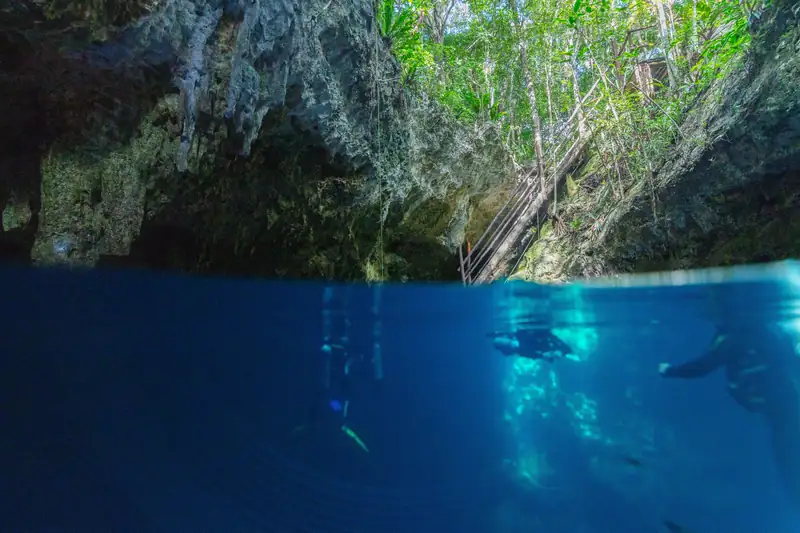
Most cenote diving near Tulum is guided cavern diving: you stay within sight of daylight and need Open Water certification plus good buoyancy. Cave diving, beyond the light, needs cave training. Dos Ojos, Car Wash and Casa Cenote suit newer cavern divers; The Pit and Angelita are deep dives that operators open only to advanced-certified divers.
Cenote diving near Tulum mostly means guided cavern diving. You swim through flooded caverns on a fixed line, always within sight of daylight from the entrance, and you need only an Open Water certification plus good buoyancy. Cave diving, which goes beyond the light, is a different sport that needs cave training. The classic cavern dives are at Dos Ojos, with Car Wash and Casa Cenote as other easy options; The Pit and Cenote Angelita are deep dives that operators reserve for advanced-certified divers.
Cavern vs cave diving
This is the distinction that decides what you can book.
|
Cavern dive |
Cave dive |
| Daylight |
Always visible from the entrance |
Left behind |
| Certification |
Open Water, good buoyancy |
Cave certification |
| Guide |
Required; divemaster or instructor who is also a full cave diver |
Training follows local rules |
| Group size |
Up to 4 divers per guide |
Set by cave training |
| Air |
Rule of thirds: turn back after a third |
Set by cave training |
| Passages |
No tight spaces |
Beyond the cavern zone |
The cavern rules come from a dive blog describing industry practice; we could not find an official text setting them. Cave courses in Quintana Roo are expected to follow “Rules for Cave Training in Quintana Roo” published by a body called CREER. The Quintana Roo Speleological Survey, which maps the caves, says diving in them is “a privilege, not a right”, granted by the landowners. Most cenotes here are on ejido (communal) or private land.
What certification do you need?
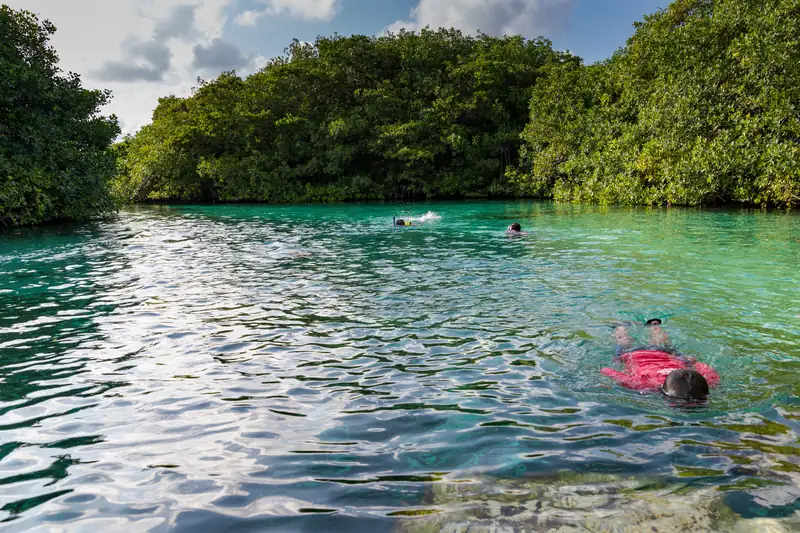
- None: a discover scuba dive. The beginner tour in our picks gives a 30-minute lesson, then up to 50 minutes underwater with an instructor in a mangrove-ringed open cenote, with no more than four people.
- Open Water: guided cavern dives at Dos Ojos, Car Wash, Casa Cenote and Gran Cenote.
- Advanced Open Water: The Pit and Angelita. Angelita operators also ask for recent dives.
- Cave certification: anything beyond the cavern zone.
Bring your certification card. Operators ask for it.
Best cenotes for diving near Tulum
Checked October 2026. Depths are what recreational dives reach, from dive operators and guides; distances are by road from Tulum town centre (routing engine, free-flow times, so allow 20 to 30 percent more).
| Site |
Recreational depth |
Level |
Distance from Tulum |
| Dos Ojos |
About 6 to 10 m |
Open Water, cavern |
21.9 km, about 28 min |
| The Pit (Dos Ojos park) |
About 30 m |
Advanced |
Next to Dos Ojos |
| Cenote Angelita |
30 to 33 m max |
Advanced, recent dives |
15.9 km south, about 15 min |
| Car Wash |
To about 14 to 15 m (one guide says 30 m) |
Open Water, beginner cavern |
8.8 km, about 10 min |
| Casa Cenote |
Shallow, halocline at about 3 m |
Open Water, beginner cavern |
10.8 km, about 14 min |
| Gran Cenote |
Cavern lines |
Open Water, cavern |
5.0 km, about 7 min |
| Cenote Calavera |
Cave entry |
Cave-certified |
3.3 km, about 6 min |
Dos Ojos
The two “eyes” are neighbouring cenotes joined by a large shared cavern. The guided cavern dives follow the Barbie line, about 6 m deep, and the Bat Cave line, together about 500 m of line, with a maximum of roughly 6 to 10 m. The water is about 24°C. If it looks familiar, the Dos Ojos system was filmed for the IMAX film Journey into Amazing Caves, the BBC’s Planet Earth and The Cave.
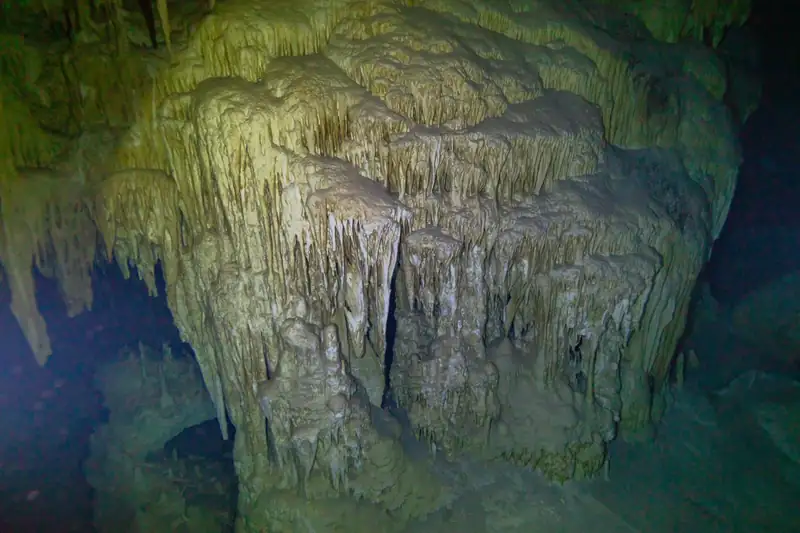
Dos Ojos has been part of the Sac Actun system since divers connected the two in January 2018, making a 347 km system that was then the longest underwater cave known. Ox Bel Ha, south-west of Tulum, is now longer, at 541.7 km as of February 2026 according to CINDAQ. The Sac Actun guide has the detail.
For certified divers, our top pick does exactly this site: two guided cavern dives on different Dos Ojos lines, lights and 5 mm wetsuits supplied, groups of four at most. Rinse your ears after the Bat Cave; bats live in it.
The Pit
Also in the Dos Ojos park, The Pit holds the deepest known passage in Quintana Roo, 119.1 m, found in 1996. Recreational dives go to about 30 m. On the way down you pass through the halocline, where fresh water meets salt in a shimmering blur, then reach a cloud of hydrogen sulfide that the dive tour in our picks places at about 25 m. Sunbeams reach to around 30 m. Freedivers use it too.
Cenote Angelita
Angelita is a deep vertical cenote about 60 m deep, roughly 17 km south of Tulum toward Muyil. A hydrogen sulfide cloud hangs at about 28 to 35 m above the salt layer and looks like a river running along the bottom. It is scuba only, with a local guide; walk-in swimmers are not accepted. Operators require Advanced Open Water and recent diving, and dive to 30 to 33 m. Some operators pair it with Casa Cenote on the same day.
Car Wash and Casa Cenote
Two gentler options. Car Wash (also called Aktun Ha) is an open pond with water lilies on top and a cave below that dive guides rate as a beginner cavern dive, to about 14 to 15 m. Casa Cenote is a shallow mangrove channel connected to the sea, with the halocline at about 3 m. Note that a crocodile bit a visitor there on 12 May 2026, and whether diving or swimming is now limited is not confirmed.
Gran Cenote and Calavera
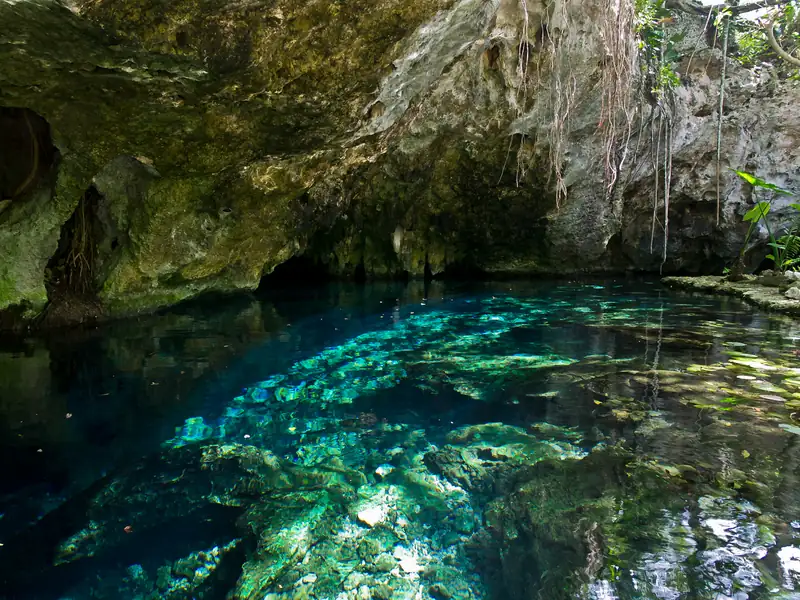
Gran Cenote, where exploration of Sac Actun began, offers guided cavern diving alongside its swimmers. At Calavera, the closest cenote to town, certified cave divers enter the cave system; it is not a standard cavern-tour site.
Cenote freediving
The Pit is popular with freedivers, who dive on a single breath. We found no published rules specific to freediving at the cenotes, so go with a local freediving instructor and ask the operator which sites allow it.
What cenote diving costs
Dive site fees are paid at the gate in cash and are not published officially; the cenote entrance fees guide has what is reported. Packaged dives on GetYourGuide, checked October 2026: a discover scuba dive from $167, two Dos Ojos cavern dives from $199, and The Pit plus Dos Ojos from $230 per person. These dive tours have few reviews so far (6 to 12 each), so read them before you book.
Before you go
Swimmers and snorkelers have more options than divers: see the cenote swimming guide. For how the caves formed, read what is a cenote, and for every guided trip, the tours page.