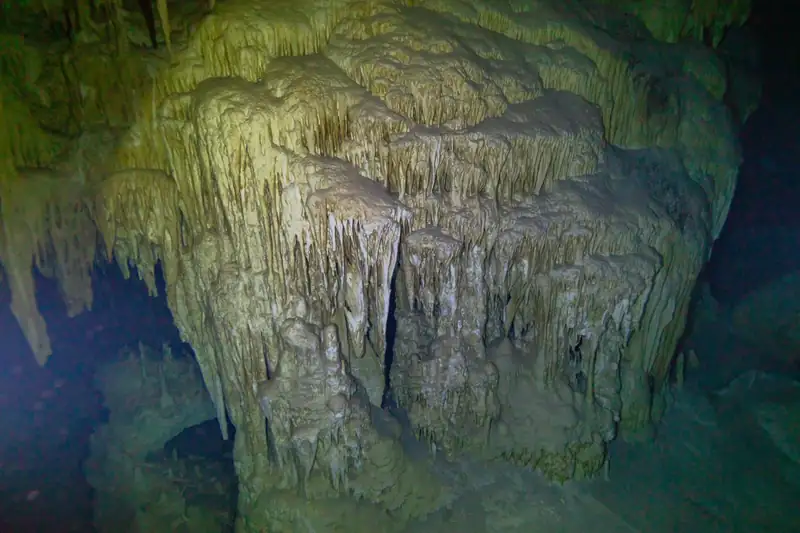
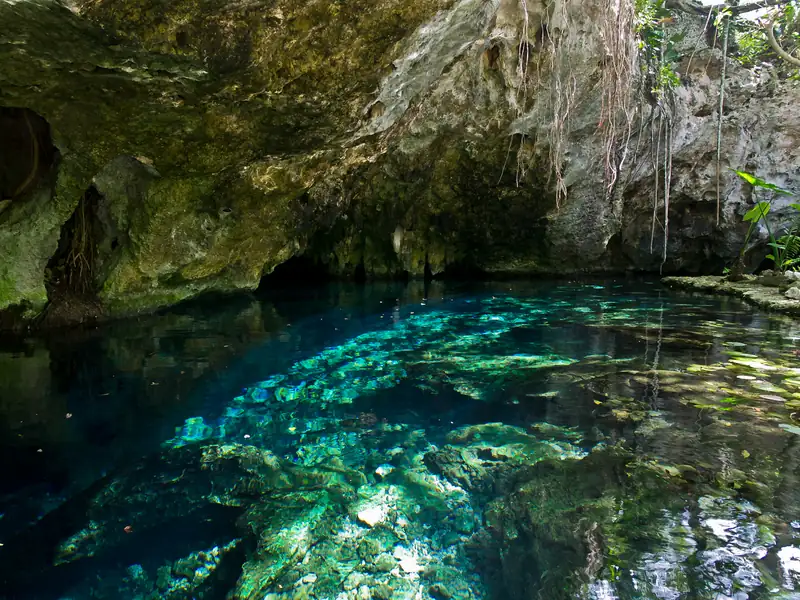
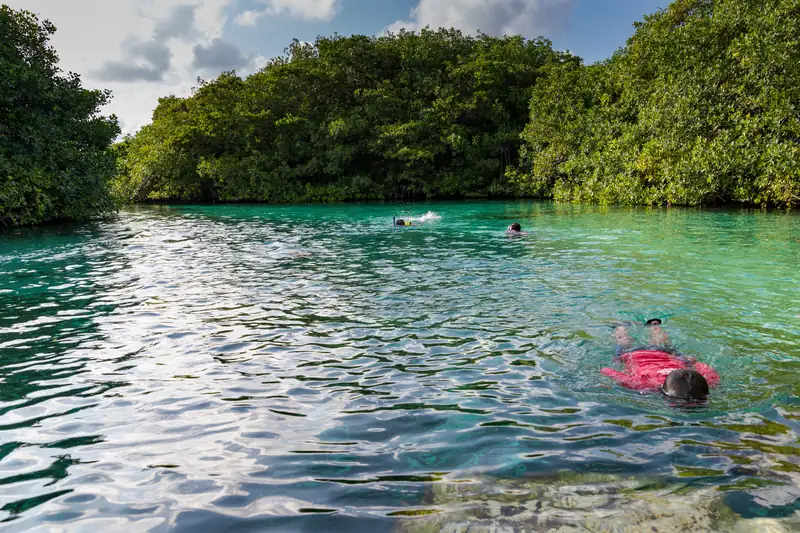
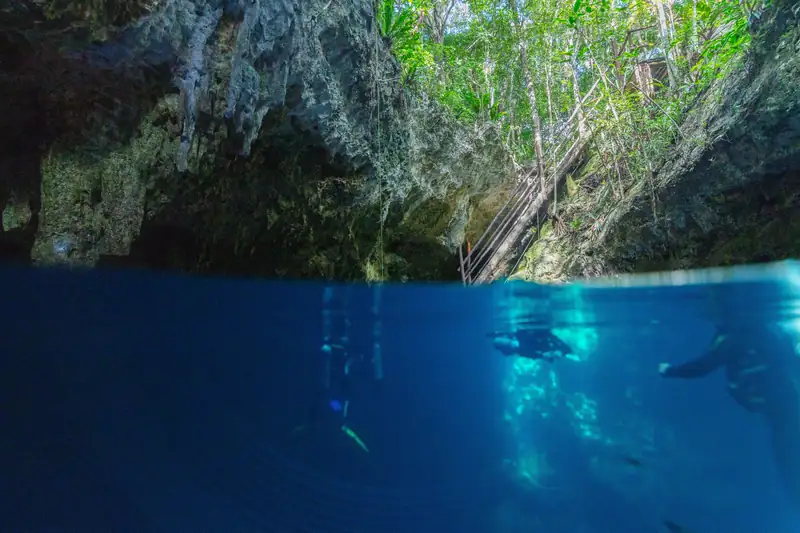
For the Maya, cenotes were the main year-round water source on a peninsula with almost no rivers, and places for offerings and burials. Archaeologists read them as openings to Xibalba, the underworld. The written evidence of sacrifice is Diego de Landa's account of Chichén Itzá, about 1566. No source ties sacrifice to Tulum's swimming cenotes.
For the Maya, a cenote was first a well. The Yucatán Peninsula has almost no rivers on the surface, so these holes in the limestone were the main year-round source of drinking water. They were also places for offerings and burials, and archaeologists believe the Maya saw them as openings to Xibalba, the underworld. The written record of human sacrifice in a cenote comes from one place, Chichén Itzá, in an account by a Spanish bishop around 1566. No source ties sacrifice to the cenotes people swim in around Tulum.
The Maya word: tsʼonoʼot
“Cenote” is a Spanish borrowing of the Yucatec Maya tsʼonoʼot, also written dzonot or tz’onot. The word covered any place where you could reach groundwater. A broad open pool counted. So did a narrow shaft into a dark cave.
That is a practical definition, and it fits a practical need. With no rivers to draw from, a village needed a way down to the water table. The what is a cenote guide explains how the holes form.
Water first: the cenote at the Tulum ruins
Tulum itself shows the practical side. The walled Maya port on the cliff, built roughly between 1200 and 1450 and a port for Cobá, had a small cenote near the north side of its wall that supplied fresh water. One building, the Casa del Cenote (Structure 35), is named for a cenote at its southern base, and a small tomb was found inside it. Water and burial, in one spot.
You can see it on a visit to the Tulum ruins. From 20 July 2026, a foreign visitor pays 165 MXN for the archaeological zone and national park together, plus 100 MXN to enter Parque del Jaguar, under the federal decree of 17 July 2026. None of the sources we used describes it as a swimming spot.
Xibalba: a modern reading
Xibalba is the Maya underworld. It appears in the Popol Vuh, a K’iche’ Maya text from highland Guatemala. In that text, though, the road to Xibalba is not described as a cenote.
The cenote-as-portal idea comes from archaeology. Researchers who study ritual cave use, such as the contributors to Brady and Prufer’s 2005 book In the Maw of the Earth Monster, read caves and cenotes as places the Maya connected with the underworld. Finds support the reading. In 2008 the archaeologist Guillermo de Anda reported a submerged altar and causeway in a Yucatán cenote, though his interpretation is contested. Cenotes are also described as the home of Chaac, the rain god.
So the honest version is: archaeologists believe the Maya saw cenotes as openings to Xibalba. You will hear tour guides say it as plain fact, and you will hear names and legends for individual cenotes, such as Calavera, Car Wash or Dos Ojos. Those names are modern nicknames with no early source behind them.
The Sacred Cenote at Chichén Itzá
This is where the sacrifice stories come from. Diego de Landa, a Spanish bishop, wrote his Relación de las cosas de Yucatán around 1566 (one page dates it 1574). It survives only as an abridged copy from about 1660. In it he describes people thrown alive into the Sacred Cenote at Chichén Itzá in times of drought, along with offerings of precious objects.
The cenote itself backed him up, at least in part. Edward H. Thompson began dredging it in 1904 and brought up skeletons and offerings. Later work counted at least 120 individuals.
But one cenote is not every cenote. At Punta Laguna, researchers studied about 120 individuals and found no signs of sacrifice on any of them. Bones in a cenote can mean burial or offering, and the evidence has to be read site by site. For the cenotes around Tulum that visitors swim in, we found no source that links them to sacrifice at all.
If you want to stand at the edge of the Sacred Cenote, the Chichén Itzá from Tulum guide covers the day trip, driving or by tour.
Naia and Hoyo Negro
The oldest human story in these caves predates the Maya by thousands of years.
In 2007, the cave divers Alejandro Álvarez, Alberto Nava and Franco Attolini reached a bell-shaped flooded pit called Hoyo Negro, “black hole”, in the cave networks north of Tulum. On the floor lay the skeleton of a teenage girl, about 15 or 16 years old, alongside the bones of Ice Age animals. She has since been named Naia. She lived 12,000 to 13,000 years ago.
The project was directed by Pilar Luna Erreguerena of INAH, Mexico’s national institute of anthropology and history, and the results appeared in Science in 2014 (Chatters and colleagues, “Late Pleistocene Human Skeleton and mtDNA Link Paleoamericans and Modern Native Americans”). Her mitochondrial DNA, inherited through the mother’s line, belongs to haplogroup D1, which links her to modern Native Americans. The researchers describe her as the oldest, most complete and genetically intact human skeleton in the New World.
Reports disagree on how deep she lay: an AFP report put the remains about 41 m below sea level, while a UC San Diego record describes a hole 50 m deep. Sources also disagree on which cave system Hoyo Negro belongs to. Either way, it is reachable only by technical cave divers and is not open to visitors.
The caves around it are part of the same story. In January 2018 divers connected Sac Actun and Dos Ojos into one 347 km system, at the time the longest underwater cave known. Ox Bel Ha, also near Tulum, has since passed it, at 541.7 km as of February 2026 according to CINDAQ. The Sac Actun guide covers that system.
Visiting cenotes with respect
Today most cenotes near Tulum are run by ejidos (communal landholding groups) or private owners. Dos Ojos, for example, is on the land of Ejido Jacinto Pat. The rules at the gate are practical rather than ceremonial: shower before you swim, skip sunscreen and repellent, wear the life jacket where it is required, and do not touch or hang on the rock formations. The cenote swimming guide lists them.
If you want to see cave cenotes with people who live nearby, the top-pick tour goes with young guides from the Chemuyil community to three dark cave cenotes, with headlamps, then back to the village for a home-cooked meal. For certified divers, the cenote diving guide covers the cavern dives at Dos Ojos, and the tours page has the rest.