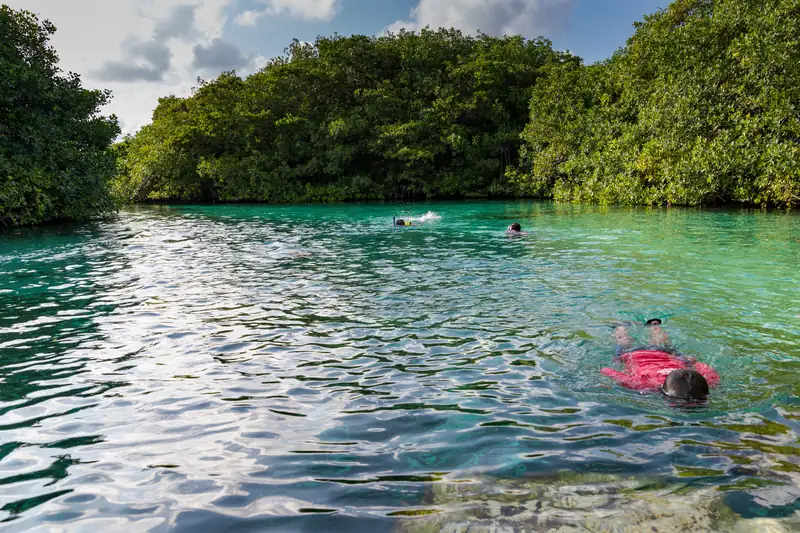
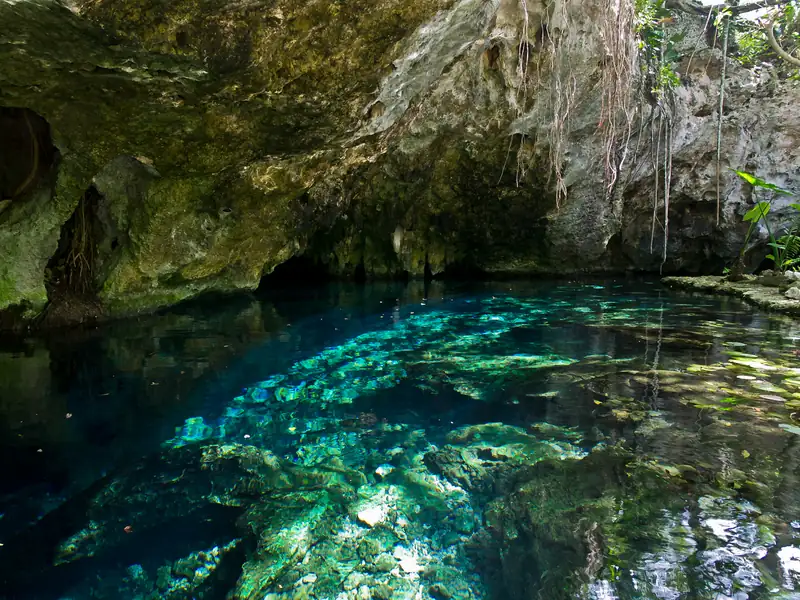
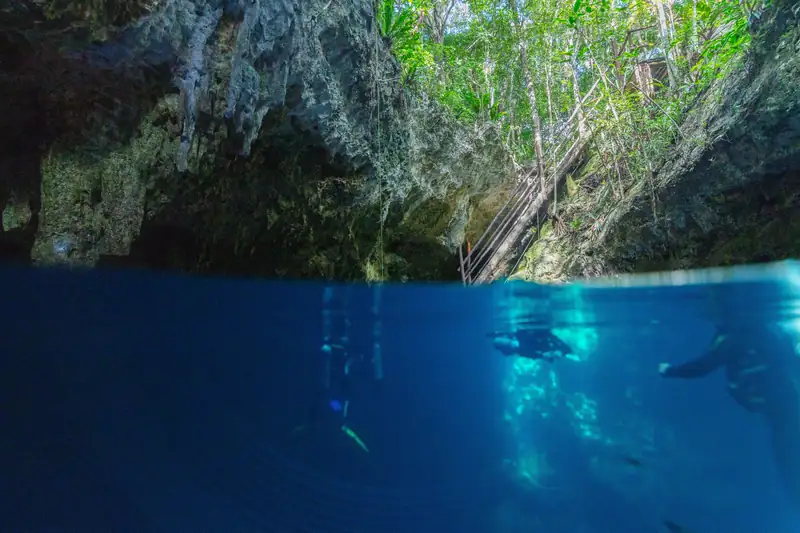
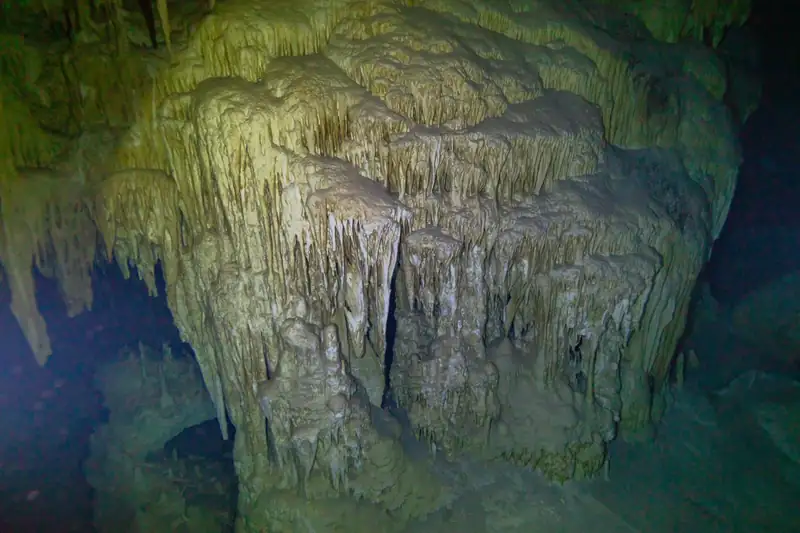
You can swim and snorkel in most cenotes around Tulum. The water stays around 24 to 25°C all year, cooler than the sea. Expect to shower before you get in, skip sunscreen and repellent, and wear a life jacket where the cenote requires one. Bring cash pesos in small notes, water shoes and a towel.
Yes, you can swim in the cenotes around Tulum, and snorkeling is the best way to see them. The water is clear, fresh and around 24 to 25°C all year, cooler than the sea. Every cenote has its own rules, but the core ones repeat: shower before you get in, wear no sunscreen or repellent, put on a life jacket where it is mandatory, and do not touch the rock formations. Bring cash pesos, water shoes and a towel, and arrive at opening time to beat the crowds.
Can you swim in cenotes? Where to go
Most cenotes near Tulum are open for swimming. Two well-known ones are not: Cenote Angelita is for scuba divers with a guide, and The Pit at Dos Ojos is a dive site. The rest suit different swimmers.
| Cenote |
Type |
Distance from town |
Best for |
Watch out for |
| Gran Cenote |
Semi-open, cavern section |
5.0 km, Cobá road |
Snorkeling, turtles, first visit |
Crowds after mid-morning |
| Cenote Calavera |
Semi-open, jump holes |
3.3 km, Cobá road |
Jumping, strong swimmers |
Deep water, not for children |
| Cristal and Escondido |
Open |
4.8 km, Hwy 307 south |
Quiet swims, jump spots |
Ticket rules unclear in 2026 |
| Zacil-Ha |
Open, about 3 m deep |
9.2 km, Cobá road |
Families, zipline into the water |
Fins banned for surface swimmers |
| Car Wash |
Open, water lilies |
8.8 km, Cobá road |
A quieter dip |
A small crocodile has been reported |
| Casa Cenote |
Open mangrove channel |
10.8 km, Hwy 307 north |
Snorkeling, kayaks |
Crocodile bite on 12 May 2026 |
| Dos Ojos |
Cavern |
21.9 km, Hwy 307 north |
Snorkeling the cavern |
Life vest compulsory |
Distances are by road from the town centre (routing engine, October 2026). The cenote map shows them all, and the getting around guide covers bikes, taxis and colectivos.
A note on Casa Cenote: its resident crocodile bit an elderly visitor on 12 May 2026, after visitors had thrown stones at it. A week later Tulum’s environment department said it was working on signs and possible limits on swimming where crocodiles live. Whether any limit is now in force is not confirmed. Ask at the gate.
Cenote snorkeling: what you see
With a mask you see what the surface hides. At Gran Cenote there are freshwater turtles, and the cavern section runs under the rock between two open pools. At Casa Cenote you may cross the halocline, the blurry line where fresh water sits on salt water, only about 3 m down. At Dos Ojos you float over the cavern with light coming through the two openings.
Some stretches need a guide. The Bat Cave at Dos Ojos is a guided snorkel, and the river-like section at Taak Bi Ha needs a local guide with a lamp. Do not swim past a marked cavern line on your own.
Gran Cenote rents snorkels; 2026 guides list 80 to 150 MXN. Your own mask saves the rental.
If you would rather not juggle gear and transport, the top-pick tour leaves from central Tulum for Gran Cenote, the jump platforms at Cenote Zemway and Casa Cenote, with snorkel gear, towels and transport between stops.
The rules: showers, sunscreen and the rest
Every cenote posts its own rules, so read the board at the gate. These come up at nearly all of them.
Shower first. Gran Cenote, Dos Ojos and others have showers and expect you to use them.
No sunscreen, repellent, make-up or oils. This is the rule that surprises people. A study of Riviera Maya groundwater found sunscreen compounds, including oxybenzone, rising as tourism returned after COVID-19. On “biodegradable” or “reef safe” sunscreen the guides disagree: some cenotes allow it and some do not. We found no official list. Wearing none is the only answer that works everywhere; cover up with a rash guard or long sleeves instead.
Life jackets. Mandatory for swimmers at Gran Cenote and Dos Ojos, and children under 12 are expected to wear one generally. One 2026 blog says Gran Cenote no longer includes the jacket in the ticket, while most guides say it does; bring cash in case.
Hands off. Do not touch, stand on or hang from formations or tree roots.
Fins. Zacil-Ha and Nicte-Ha ban them for surface swimmers.
Are cenotes safe?
At the managed swimming cenotes, the hazards are specific and easy to avoid if you know them.
- Deep water. Calavera has no shallow end. You jump through a hole, roughly 2.5 to 3 m, into water reported at 7.6 to 15 m deep, and guides say it is not for nervous swimmers or young children.
- Caves. Never swim past the marked line or into an unmarked cenote. Cave diving without training kills, and snorkelers have no business beyond the light.
- Crocodiles. They live in some mangrove and coastal cenotes. Keep your distance and never feed or provoke them.
- Bats. Cave cenotes have them. Divers coming out of the Dos Ojos Bat Cave are told to rinse their ears.
Can you drink cenote water?
No. It is untreated groundwater, and a 2013 study (Leal-Bautista and colleagues) assessed fecal contamination in groundwater from the Tulum region. Do not drink it, and try not to swallow it.
Why do cenotes close at 5?
Most open between 8:00 and 9:00 and close between 17:00 and 18:00, according to a 2026 guide. No authority sets that hour that we could find. A July 2025 article in Por Esto, the Yucatán daily, gives the reasons people cite: light fades fast inside caverns, raising the risk of falls and getting lost underwater; bats, snakes and insects get active; and the Maya belief that aluxes, small guardian spirits, come out at dusk.
What to bring: the checklist
Checked October 2026, from 2026 guides and the cenotes’ posted rules.
| Bring |
Why |
| Cash pesos in small notes |
Gates take cash; no ATMs; cards, where accepted, often carry a surcharge |
| Coins |
Lockers often need them |
| Water shoes |
Rocky entries and wet steps |
| Towel |
Rarely rented |
| Snorkel mask |
Rentals cost extra |
| Rash guard or long sleeves |
Sun cover instead of sunscreen |
| Dry bag |
Phone and cash near the water |
| Drinking water |
Cenote water is not safe to drink |
| Certification card |
Divers only |
| Leave behind: sunscreen, repellent, make-up |
Most cenotes ask you not to wear them |
Prices are not on any official website. For Gran Cenote, several 2026 guides report about 500 MXN for an adult; the cenote entrance fees guide has the reported ranges for the others.
When to swim
Get to Gran Cenote at opening (8:00) or after about 14:30 to miss the tour groups. Cenotes are inland fresh water, so seaweed on the beaches does not reach them; the sargassum guide explains the season, and the best time to visit guide covers the weather.
Certified divers, or anyone curious about a first dive, should read the cenote diving guide. For the history behind the water, see what is a cenote. Guided swims and snorkel tours are on the tours page.